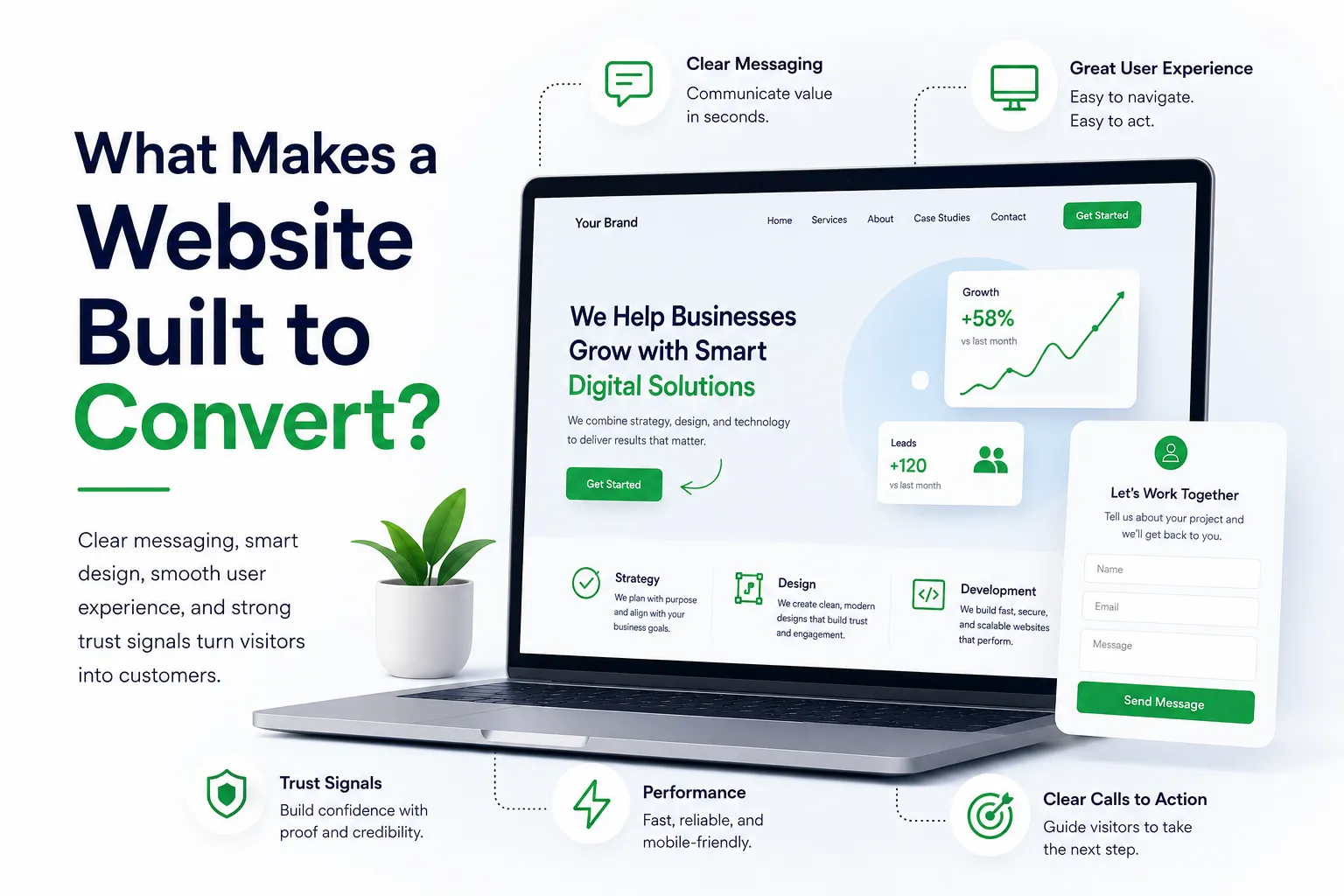
A good website should not just sit online and look polished. It should help people understand your business, trust your brand, and take the next step.
Many businesses invest in a new website because the old one looks outdated. That can be a valid reason, but appearance is only part of the job. A website also needs to support real business goals, such as generating leads, booking calls, increasing inquiries, improving customer experience, or helping people make a confident decision.
That is what it means to build a website for conversion.
A website built to convert connects clear messaging, smart user experience, strong design, reliable development, and measurable action. It does not just present information. It guides the right visitor toward the right next step.
What Does “Conversion” Mean on a Website?
A conversion is any meaningful action a visitor takes on your website.
For one business, that may mean booking a consultation. For another, it may mean requesting a quote, calling the office, filling out a form, making a purchase, signing up, or visiting a physical location.
A conversion-focused website makes those actions easier.
It does not make visitors guess what you do. It does not hide important information. It does not create friction at the moment someone is ready to act. Instead, it gives users a clear path from interest to decision.
The goal is simple: help the right people understand your value and take action with confidence.
Clear Messaging Comes First
Before design, animation, or advanced features, a website needs a clear message.
Visitors should quickly understand:
- What your business does
- Who you help
- Why your offer matters
- What makes you different
- What they should do next
If someone lands on your homepage and cannot explain what you do within a few seconds, the website is not doing its job. Design may create the first impression, but messaging creates understanding.
Strong website copy should speak directly to the visitor’s needs. It should avoid vague claims and focus on practical value. Instead of saying your business provides “innovative solutions,” explain what your service helps customers improve, avoid, solve, or achieve.
Clear messaging also improves the performance of other marketing channels. SEO, paid ads, social media, landing pages, and email campaigns all work better when the website has a strong message behind it.
User Experience Should Reduce Friction
Good user experience is not about making a website more complicated. It is about making the experience easier.
Visitors should be able to move through the site without confusion. Navigation should be simple. Pages should be organized in a way that feels natural. Important details should be easy to find.
Forms should be short enough to complete without making someone question their life choices, which is a surprisingly low bar that many websites still manage to trip over.
A website built to convert usually includes:
- Simple navigation
- Clear page structure
- Mobile-friendly design
- Fast access to contact information
- Easy-to-understand service pages
- Short and functional forms
- Clear calls to action
Every page should have a purpose. If a page does not help the visitor understand, trust, compare, decide, or act, it may be adding noise instead of value.
Mobile experience also matters. Many users will visit your site from a phone before they ever see it on a desktop. If the mobile version is slow, crowded, or difficult to use, your business can lose potential leads before the conversation even starts.
Trust Signals Help Visitors Feel Confident
People rarely take action just because a website looks nice. They take action when they feel enough confidence to move forward.
Trust signals help reduce uncertainty. They show visitors that your business is real, experienced, and capable.
Useful trust signals may include:
- Case studies
- Client logos
- Testimonials
- Team information
- Industry experience
- Clear service details
- Professional visuals
- Before and after examples
- Certifications or partnerships, when relevant
- Easy-to-find contact information
For service-based businesses, trust is especially important. A visitor may be comparing multiple providers before making a decision. If your website explains your process, shows relevant work, and makes your business feel credible, it becomes easier for that person to choose you.
Trust does not need to be loud. It needs to be specific, believable, and easy to find.
Design Should Support the User Journey
Strong visual design matters, but design should support the goal of the page.
A website can look modern and still fail if users do not know where to click, what to read, or how to take the next step. Good design helps organize information, create visual priority, and guide attention.
A well-designed website should make it easy to understand:
- The main message of the page
- The most important action
- The difference between services or offers
- The next step in the customer journey
- The reason to trust the business
Design should not compete with the message. It should make the message easier to understand.
This is especially important for landing pages. If a paid ad brings someone to a page, the page needs to match the intent of the visitor. The headline, copy, visuals, and call to action should all support one clear goal.
Development and Performance Matter
A conversion-focused website needs more than good design. It also needs reliable development and strong technical performance.
A website should be fast, responsive, easy to update, and structured properly. If pages load slowly, forms break, layouts shift, or the mobile experience feels clumsy, conversion will suffer.
Strong web development should support:
- Page speed
- Responsive design
- SEO-friendly structure
- Clean forms and calls to action
- Accessibility and readability
- Secure and stable functionality
- Analytics and tracking
- Easy content management
Performance affects every marketing channel. If SEO brings visitors to a slow page, the opportunity is weakened. If paid media sends traffic to a confusing landing page, budget gets wasted. If users try to contact you and the form does not work, the site has failed at the worst possible moment.
Your website is not separate from your marketing. It is where much of your marketing either succeeds or falls apart.
Conversion Does Not End at the Website
A website can create the first action, but growth depends on what happens next.
After someone fills out a form, books a call, makes a purchase, or requests information, the business needs a follow-up process. That may include CRM workflows, email automation, reporting, sales tracking, or internal systems that help the team respond quickly.
This is why web design should connect to the broader digital system.
A stronger growth system may include:
- SEO and AI search visibility
- Paid media campaigns
- Social media content
- Landing pages
- CRM and automation
- Analytics dashboards
- Performance reporting
- Ongoing website optimization
When these pieces work together, the website becomes more than a digital brochure. It becomes part of a connected growth system.
How Visionary AI Approaches Conversion-Focused Web Design
At Visionary AI, we see your website as part of a larger growth system.
Strong web design should connect your message, user experience, campaign strategy, analytics, and follow-up process. A website should help people understand your business, trust your offer, and take meaningful action.
That may mean building a new website, improving an existing one, creating landing pages, supporting e-commerce, or refining the user journey. The goal is always the same: help the right visitors understand your value and move forward with confidence.
We approach web design, development, and conversion together, because a good website should not only look professional. It should support marketing, improve customer experience, and give your business a stronger foundation for growth.
Final Thoughts
A website built to convert is built with purpose.
It has clear messaging, simple navigation, strong trust signals, reliable performance, and calls to action that make sense. It connects design with business strategy. It supports marketing instead of sitting apart from it.
A good website does not just show people who you are. It helps them understand why they should choose you and what to do next.