Many businesses do not have a marketing activity problem. They have an alignment problem.
They invest in SEO, paid ads, social media, website updates, content, and reporting, but those pieces often operate separately. The result is familiar: traffic without quality leads, campaigns without clear direction, content without purpose, and reports that show numbers without guiding decisions.
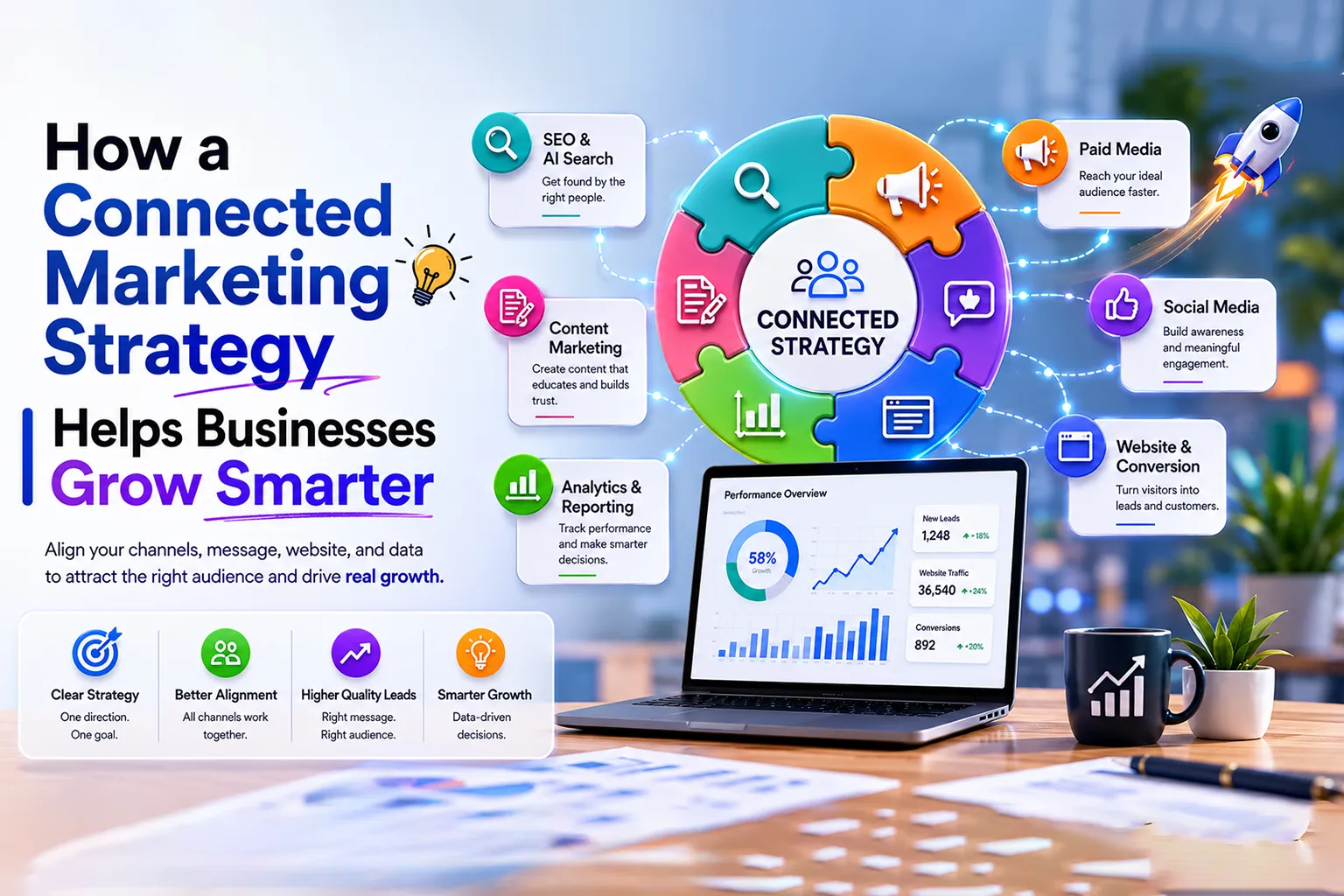
A connected marketing strategy brings these pieces into one system. It helps your audience, messaging, channels, website, campaigns, and tracking work toward the same business goals.
Instead of treating marketing as a list of separate tasks, a connected strategy turns it into a clearer growth system.
What Is a Connected Marketing Strategy?
A connected marketing strategy is a plan that aligns every major part of your marketing around the same business goals.
It connects:
- Audience insight
- Brand messaging
- SEO and AI search visibility
- Paid media
- Social media and content
- Website experience
- Landing pages
- Conversion goals
- Analytics and reporting
The goal is not more marketing activity. It is better alignment.
When marketing is connected, every channel has a role. Every campaign supports a clear goal. Every piece of content fits into a larger customer journey. Every report helps the business make better decisions.
Without that connection, marketing can become busy without becoming effective. A business may be posting, advertising, optimizing, reporting, and still wondering why growth feels unclear.
Delightful, if your hobby is paying for confusion.
Why Disconnected Marketing Holds Businesses Back
Disconnected marketing creates waste.
A business may be spending money, producing content, and running campaigns, but still struggle to understand what is actually driving growth.
Common signs of disconnected marketing include:
- Campaigns that feel random or reactive
- Social content that does not support business goals
- Paid ads that bring traffic but not quality leads
- SEO pages that rank but do not convert
- Landing pages that do not match campaign messaging
- Reports that show data without clear action
- Teams working on separate priorities
This creates confusion for the business and for the customer.
A potential customer may see one message in an ad, another message on social media, and a different message on the website. They may click through from a campaign and land on a page that does not answer their question. They may be interested, but not confident enough to take the next step.
That friction weakens performance across every channel.
The Core Parts of a Connected Growth System
A stronger marketing system does not rely on one channel to do all the work. It connects several key parts so they support each other.
Strategy and Positioning
Strategy defines the direction.
Before choosing platforms or launching campaigns, a business needs to understand its audience, offer, market position, goals, and message.
Good strategy answers questions like:
- Who are we trying to reach?
- What problem are we helping them solve?
- Why should they choose us?
- Which channels matter most?
- What action do we want them to take?
- How will we measure progress?
Without a strategy, marketing becomes a guessing game with invoices attached.
SEO and AI Search Visibility
Search visibility helps people find your business when they are actively looking for answers, services, or solutions.
Traditional SEO still matters, but search behaviour is changing. People now discover businesses through search engines, maps, social platforms, AI-powered answers, and recommendation-based content.
A connected strategy makes sure your website, service pages, blog content, case studies, and brand messaging help both people and search systems understand what your business does.
Clear content supports visibility. Clear structure supports trust. Clear service pages support action.
Paid Media
Paid media can help your business reach the right audience faster, but it works best when it is connected to strategy, messaging, landing pages, and tracking.
A campaign should not exist in isolation. The ad should match the audience. The offer should match the landing page. The landing page should match the user’s intent. The tracking should show whether the campaign is creating useful business outcomes.
Paid media without alignment can generate clicks without progress. That is an expensive way to collect disappointment.
Social Media and Content
Social media and content help your brand stay visible, relevant, and recognizable.
But content should not be created just to fill a calendar. It should support brand awareness, campaigns, customer education, trust, and engagement.
A connected content strategy gives your team clear pillars, themes, formats, and goals. It helps social media support broader marketing priorities instead of becoming a separate activity with its own mysterious weather system.
Website and Conversion
Your website is often where marketing performance is decided.
SEO, paid ads, social media, referrals, and email campaigns may bring visitors to your site, but the website needs to help them understand, trust, and act.
A connected strategy makes sure your website supports your campaigns, speaks clearly to your audience, and guides visitors toward meaningful actions such as booking a call, submitting a form, making a purchase, or requesting information.
Analytics and Reporting
Reporting should do more than collect numbers.
A useful report helps answer:
- What is working?
- What is not working?
- Where are leads coming from?
- Which campaigns are producing quality opportunities?
- Which pages are converting?
- What should improve next?
When analytics are connected to strategy, reporting becomes a decision-making tool instead of a monthly screenshot ritual.
How Connected Marketing Improves Performance
A connected marketing strategy improves performance because it reduces confusion.
It gives each channel a clear role. It helps teams make better decisions. It creates a smoother experience for the customer.
The benefits usually show up in several ways.
Clearer Direction
When strategy is clear, teams know what to focus on.
This helps prevent random campaigns, scattered content, and last-minute decisions that do not support the larger goal.
Clear direction also makes it easier to say no to tactics that may look exciting but do not fit the business.
Better Channel Alignment
SEO, paid media, content, social, and web perform better when they support each other.
A blog article can support SEO and sales conversations. A campaign landing page can support paid ads and email. Social content can reinforce brand messaging and promote key offers.
Website updates can improve conversion across every traffic source.
Each channel becomes stronger because it is not working alone.
More Consistent Customer Journeys
Customers do not think in channels. They move between search, social media, websites, ads, reviews, emails, and conversations.
A connected strategy helps create a more consistent experience across those touchpoints. The message feels clearer. The brand feels more recognizable. The next step feels easier.
That consistency builds trust.
Smarter Budget Decisions
When tracking and reporting are connected, businesses can see where the budget is creating value.
This does not mean every result will be perfect. It means decisions can be based on evidence instead of instinct, pressure, or whichever platform happens to be loudest that week.
Better data helps teams shift budget, improve campaigns, and focus on the channels that support real outcomes.
Signs Your Marketing Strategy Needs to Be Rebuilt
Not every business needs a full reset, but there are clear signs that the current approach may not be working.
You may need a stronger connected strategy if:
- Your campaigns feel disconnected across channels
- You are spending on ads, but the lead quality is poor
- Your website traffic is not turning into inquiries
- Your social content lacks direction
- Your SEO and paid media are not aligned
- Your reports show activity, but not useful insight
- Your team is unsure what to prioritize
- Your messaging changes from platform to platform
- You are launching offers without a clear campaign plan
These issues usually do not get fixed by adding one more tool or one more campaign. They need a clearer system.
How Visionary AI Approaches Connected Marketing
At Visionary AI, we see marketing as a connected growth system.
Strategy, content, search, paid media, web experience, automation, and reporting should support the same direction instead of working as separate tasks.
Our approach starts with understanding the business, audience, goals, and current digital presence. From there, we help define the right strategy, channels, messaging, content direction, conversion paths, and performance tracking.
The goal is not more marketing activity. It is clearer visibility, stronger lead quality, better customer journeys, and smarter decisions over time.
Final Thoughts
Marketing is easier to manage when the pieces work together.
SEO, paid media, social content, web design, automation, and reporting all matter. But they create more value when they are connected by strategy.
A connected marketing strategy helps your business attract the right audience, communicate more clearly, improve campaign performance, and understand what is actually driving growth.
It turns marketing from a list of disconnected tasks into a system built around direction, visibility, trust, and measurable progress.