Home
Why AI Search Optimization Matters for Modern Businesses
Why AI Search Optimization Matters for Modern Businesses
May 26, 2026
Search is no longer limited to a list of blue links.
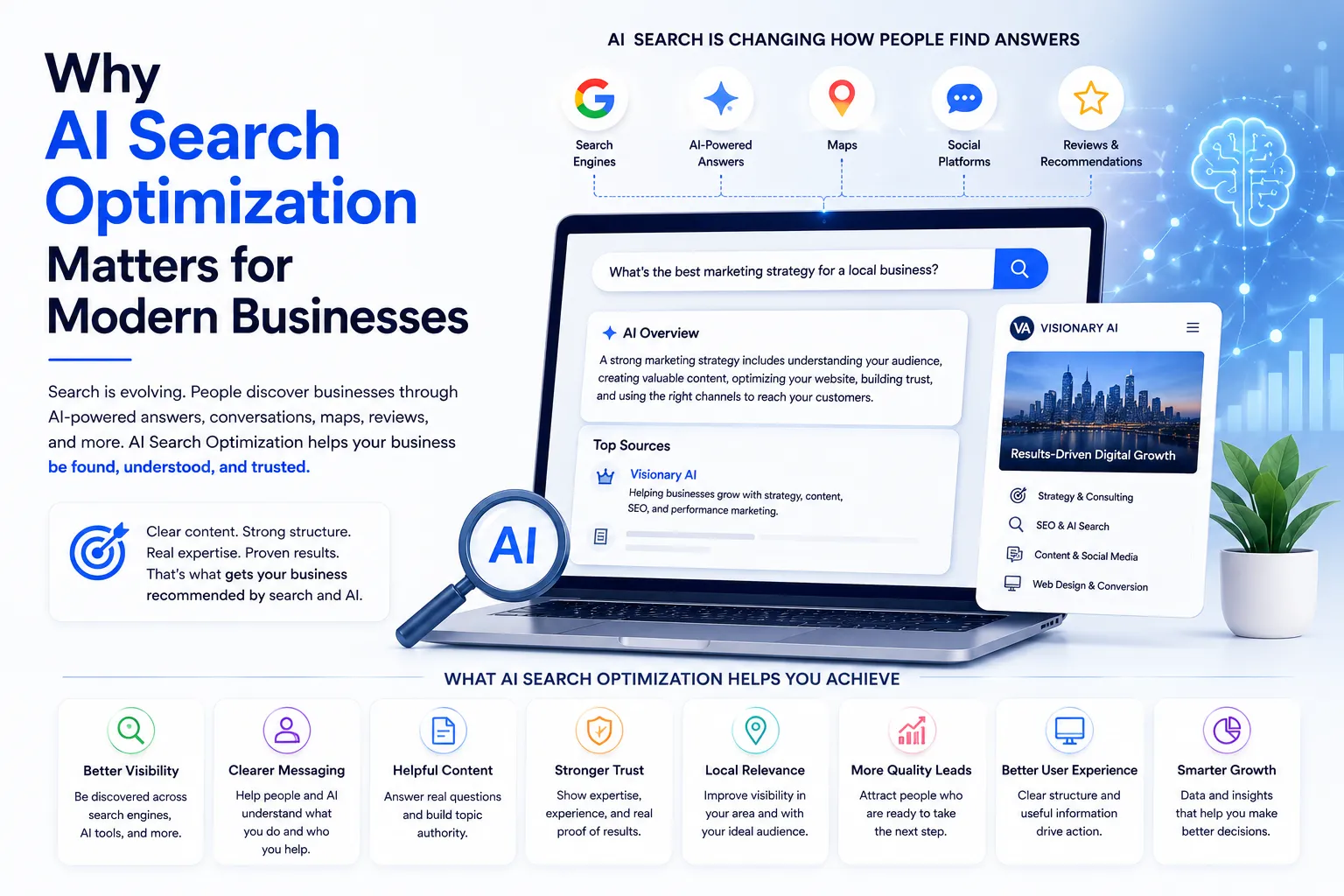
People still use Google, but they also discover businesses through AI-powered answers, maps, social platforms, reviews, and recommendation-based content. For businesses, this means visibility depends on more than keywords.
Your services, expertise, location, content, and proof need to be clear enough for both people and search systems to understand.
That is the practical side of AI search optimization.
AI search optimization is not about chasing shortcuts or trying to force your business into every AI-generated answer. It is about building a clearer, more useful digital presence so your business is easier to find, understand, and trust.
What Is AI Search Optimization?
AI search optimization is the process of improving how clearly your business, services, expertise, and content can be understood by search engines, AI-powered discovery tools, and users looking for answers.
Traditional SEO still matters. Keywords, technical structure, content quality, backlinks, and user experience all continue to play a role. AI search does not replace SEO. It adds another layer.
AI-powered search tools often respond to conversational questions, summarize information, and compare sources. That means your website needs to do more than include the right keywords.
It needs to explain your services clearly, answer real customer questions, and show signs of credibility.
A business with vague service pages, thin content, inconsistent language, and little proof of expertise will be harder to understand. A business with clear pages, helpful content, consistent terminology, and strong trust signals has a better foundation for modern search visibility.
How AI Search Is Different from Traditional SEO
Traditional search often starts with short keyword phrases. A user might search for:
“marketing agency Toronto”
“web design for dentists”
“SEO services for small business”
AI-powered discovery is often more conversational. Users may ask questions like:
What type of marketing agency should a local service business work with?
How can a dental clinic improve website conversions?
What is the difference between SEO and AI search optimization?
How can automation improve marketing follow-up?
What should a business include on a high-converting service page?
These questions are more specific, and they require clearer answers.
AI search systems may pull from multiple sources, summarize information, and try to identify which businesses, services, or resources are most relevant to the question. No business can fully control how these systems present information. Anyone promising that deserves a very long walk away from your budget.
What businesses can control is the clarity and quality of their own digital presence.
Clear content matters. Consistent service naming matters. Strong website structure matters. Trust signals matter. Helpful explanations matter.
The basics still matter. They just need to be done with more precision.
Why AI Search Matters for Businesses
AI search matters because discovery is becoming more fragmented.
A potential customer may first hear about your business on social media. Then they may search your name. Then they may compare your services through Google. Then they may ask an AI tool what to look for before hiring an agency. Then they may visit your website to make a decision.
That customer journey is not linear.
If your website does not clearly explain what you do, who you help, where you operate, and why your business is credible, you may lose visibility at several points in that journey.
For service-based businesses, AI search optimization can support:
Better service clarity
Stronger topic authority
More useful blog content
Clearer answers to customer questions
Improved local relevance
Better internal linking
Stronger trust and proof signals
More consistent brand messaging
The goal is not to write for machines. The goal is to make your business easier for people and search systems to understand.
What Businesses Need to Improve AI Search Visibility
AI search optimization works best when several parts of your digital presence are aligned.
Clear Service Pages
Your service pages should explain exactly what you offer, who it is for, and what business problem it solves.
A weak service page only lists services. A strong service page helps visitors understand the value, process, outcomes, and next step.
For example, instead of only saying “we offer web design,” a stronger page explains how web design supports user experience, conversion, SEO, credibility, and business growth.
Helpful Content
Blog content should answer real questions your audience is likely to ask.
For a marketing and digital growth agency, useful topics may include website conversion, connected marketing strategy, AI search, automation, content planning, SEO, paid media, and analytics.
Helpful content builds topical depth. It also gives your business more opportunities to appear for informational searches and support potential customers earlier in their decision process.
The key is to avoid generic articles that say very little. A useful article should give the reader a practical understanding, not just repeat obvious points with nicer formatting.
Consistent Brand Messaging
Inconsistent terminology creates confusion.
If your homepage says one thing, your service pages say another, your case studies use different labels, and your blog uses a separate naming system, users may struggle to understand your offer.
Search systems may struggle, too.
Consistent service categories, clear naming, and repeated themes help create a stronger digital footprint.
Consistency is not boring. It is how brands become easier to recognize.
Structured Information
Good structure helps people scan your content and understand it quickly.
Useful structure includes:
Clear headings
Short paragraphs
Descriptive page titles
Strong internal links
FAQ-style answers
Clear service descriptions
Organized case studies
Simple navigation
If a page is difficult for a person to understand, it is probably not well optimized for search either.
Local and Industry Relevance
For many businesses, local relevance matters.
A clinic, local service company, home improvement business, education provider, or professional service firm should make its location and audience clear.
Industry relevance also matters. A business that serves dental clinics, veterinary hospitals, home services, education providers, fitness brands, or local markets should make that experience visible where appropriate.
This helps visitors see that your business understands their context.
Trust Signals
AI search optimization is not only about content. It is also about credibility.
Trust signals may include:
Case studies
Client names or logos
Testimonials
Team information
Clear contact details
Industry experience
Specific service pages
Useful articles
Professional website design
Secure and functional pages
Trust signals help people make decisions. They also support the overall credibility of your website.
Common Mistakes Businesses Make
Many businesses want better search visibility, but their website makes it harder than it needs to be.
Common mistakes include:
Vague service pages
Thin blog content
Inconsistent service names
Generic homepage messaging
No clear explanation of the process
No case studies or proof
Weak internal linking
Outdated website content
Missing contact information
Content written only for keywords, not users
These issues are not always technical. Often, they come from an unclear strategy.
If your website does not clearly explain what your business does, search optimization becomes much harder.
How Content Strategy Supports AI Search
AI search optimization depends heavily on content strategy.
A strong content strategy helps your website cover the topics your audience cares about in a clear and organized way.
For example, a business focused on digital growth may build content around:
Website conversion
Marketing strategy
SEO and AI search
Social media content
Brand messaging
Automation
Analytics
Customer journeys
Case studies by industry
Each piece of content should have a role. Some pages educate. Some build trust. Some explain services. Some support comparison. Some guide action.
How Visionary AI Approaches AI Search Optimization
At Visionary AI, we see AI search optimization as part of a larger growth system.
Search visibility works best when service pages, content strategy, website structure, brand messaging, technical performance, and reporting are connected.
The goal is not to chase every new search trend. The goal is to make your business easier to find, easier to understand, and easier to trust.
Final Thoughts
AI search is changing how people discover and compare businesses, but the foundation is still practical.
Clear service pages matter. Helpful content matters. Strong structure matters. Trust signals matter. Consistent messaging matters.
AI search optimization is not a shortcut. It is a reason to make your digital presence clearer, more useful, and more connected.
A business that explains its value well will be easier for people to understand.