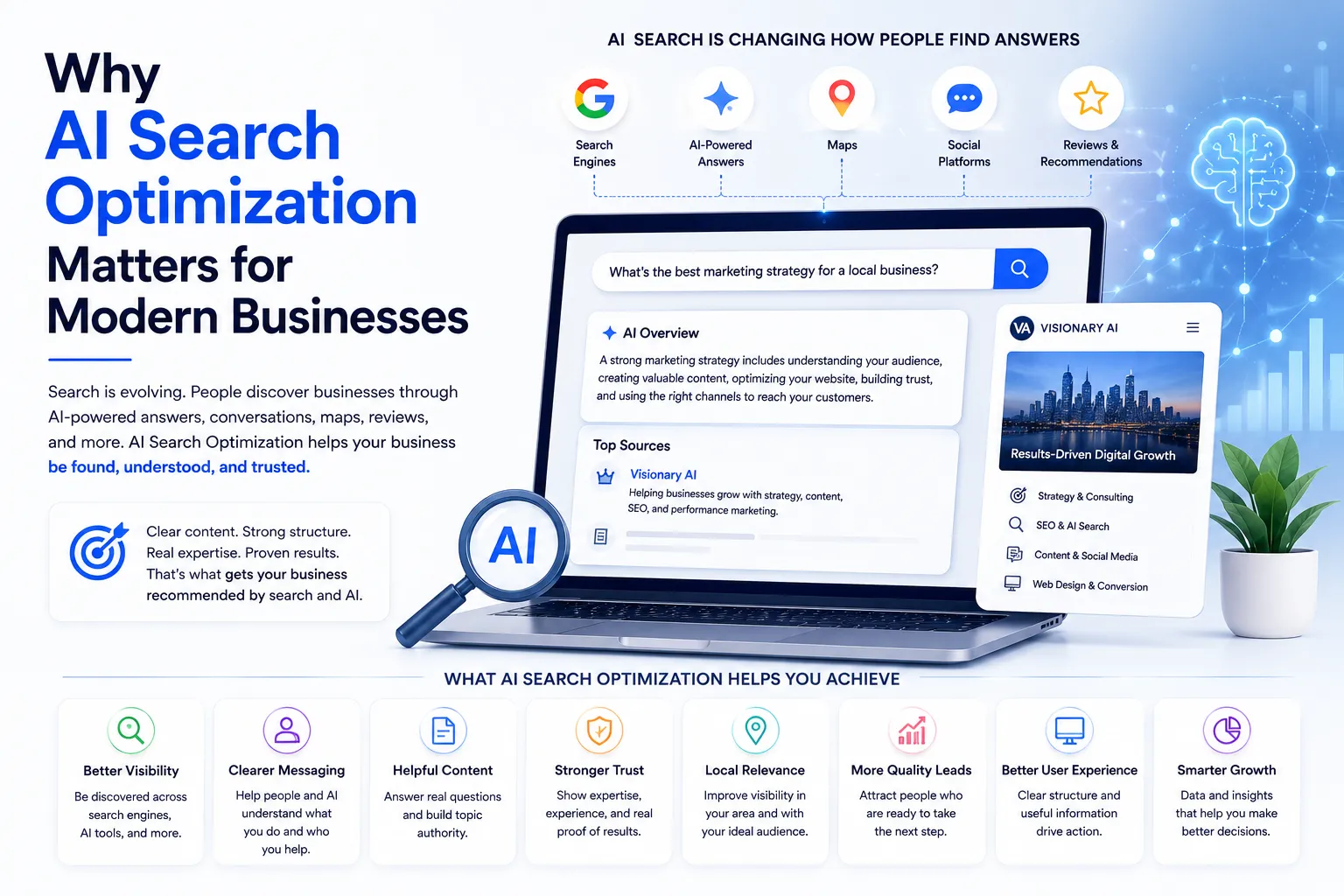
What Is AI Search Optimization?
AI search optimization is the process of improving how clearly your business, services, expertise, and content can be understood by search engines, AI-powered discovery tools, and users looking for answers. Traditional SEO still matters. Keywords, technical structure, content quality, backlinks, and user experience all continue to play a role. AI search does not replace SEO. It adds another layer. AI-powered search tools often respond to conversational questions, summarize information, and compare sources. That means your website needs to do more than include the right keywords. It needs to explain your services clearly, answer real customer questions, and show signs of credibility. A business with vague service pages, thin content, inconsistent language, and little proof of expertise will be harder to understand. A business with clear pages, helpful content, consistent terminology, and strong trust signals has a better foundation for modern search visibility.How AI Search Is Different from Traditional SEO
Traditional search often starts with short keyword phrases. A user might search for:- “marketing agency Toronto”
- “web design for dentists”
- “SEO services for small business”
- What type of marketing agency should a local service business work with?
- How can a dental clinic improve website conversions?
- What is the difference between SEO and AI search optimization?
- How can automation improve marketing follow-up?
- What should a business include on a high-converting service page?
Why AI Search Matters for Businesses
AI search matters because discovery is becoming more fragmented. A potential customer may first hear about your business on social media. Then they may search your name. Then they may compare your services through Google. Then they may ask an AI tool what to look for before hiring an agency. Then they may visit your website to make a decision. That customer journey is not linear. If your website does not clearly explain what you do, who you help, where you operate, and why your business is credible, you may lose visibility at several points in that journey. For service-based businesses, AI search optimization can support:- Better service clarity
- Stronger topic authority
- More useful blog content
- Clearer answers to customer questions
- Improved local relevance
- Better internal linking
- Stronger trust and proof signals
- More consistent brand messaging
What Businesses Need to Improve AI Search Visibility
AI search optimization works best when several parts of your digital presence are aligned.Clear Service Pages
Your service pages should explain exactly what you offer, who it is for, and what business problem it solves. A weak service page only lists services. A strong service page helps visitors understand the value, process, outcomes, and next step. For example, instead of only saying “we offer web design,” a stronger page explains how web design supports user experience, conversion, SEO, credibility, and business growth.Helpful Content
Blog content should answer real questions your audience is likely to ask. For a marketing and digital growth agency, useful topics may include website conversion, connected marketing strategy, AI search, automation, content planning, SEO, paid media, and analytics. Helpful content builds topical depth. It also gives your business more opportunities to appear for informational searches and support potential customers earlier in their decision process. The key is to avoid generic articles that say very little. A useful article should give the reader a practical understanding, not just repeat obvious points with nicer formatting.Consistent Brand Messaging
Inconsistent terminology creates confusion. If your homepage says one thing, your service pages say another, your case studies use different labels, and your blog uses a separate naming system, users may struggle to understand your offer. Search systems may struggle, too. Consistent service categories, clear naming, and repeated themes help create a stronger digital footprint. Consistency is not boring. It is how brands become easier to recognize.Structured Information
Good structure helps people scan your content and understand it quickly. Useful structure includes:- Clear headings
- Short paragraphs
- Descriptive page titles
- Strong internal links
- FAQ-style answers
- Clear service descriptions
- Organized case studies
- Simple navigation
Local and Industry Relevance
For many businesses, local relevance matters. A clinic, local service company, home improvement business, education provider, or professional service firm should make its location and audience clear. Industry relevance also matters. A business that serves dental clinics, veterinary hospitals, home services, education providers, fitness brands, or local markets should make that experience visible where appropriate. This helps visitors see that your business understands their context.Trust Signals
AI search optimization is not only about content. It is also about credibility. Trust signals may include:- Case studies
- Client names or logos
- Testimonials
- Team information
- Clear contact details
- Industry experience
- Specific service pages
- Useful articles
- Professional website design
- Secure and functional pages
Common Mistakes Businesses Make
Many businesses want better search visibility, but their website makes it harder than it needs to be. Common mistakes include:- Vague service pages
- Thin blog content
- Inconsistent service names
- Generic homepage messaging
- No clear explanation of the process
- No case studies or proof
- Weak internal linking
- Outdated website content
- Missing contact information
- Content written only for keywords, not users
How Content Strategy Supports AI Search
AI search optimization depends heavily on content strategy. A strong content strategy helps your website cover the topics your audience cares about in a clear and organized way. For example, a business focused on digital growth may build content around:- Website conversion
- Marketing strategy
- SEO and AI search
- Social media content
- Brand messaging
- Automation
- Analytics
- Customer journeys
- Case studies by industry